
Read any Chinese menu
Know what you're actually ordering — and talk to the staff while you're at it.
Coming to the App Store
Know what you're actually ordering — and talk to the staff while you're at it.
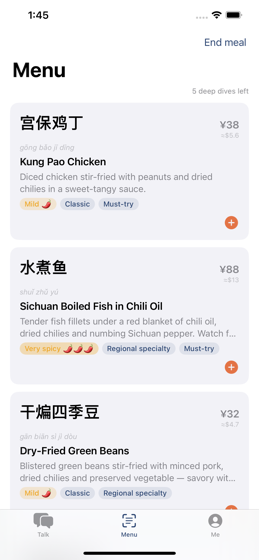
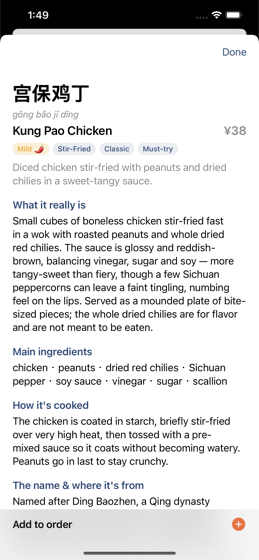
"Kung Pao Chicken" tells you nothing if you've never seen it. ChinaCue tells you what actually lands on the table.
Small cubes of boneless chicken stir-fried fast in a wok with roasted peanuts and whole dried red chilies. The sauce is glossy and reddish-brown — more tangy-sweet than fiery, though a few Sichuan peppercorns can leave a faint tingling, numbing feel on the lips. The whole dried chilies are for flavour and are not meant to be eaten.
It also tells you the things nobody warns you about: which dishes are bone-in, which hide many fine bones, which arrive scalding, which you have to peel, and which will make your lips go numb.
Restaurant Wi-Fi in China usually needs a Chinese phone number, which most travellers don't have. So the parts you need most don't need a connection at all.
The dish database ships inside the app. Scanning a menu and reading the explanations works in airplane mode.
Your phone reads the menu itself. No upload, no waiting for a server before the first dish appears.
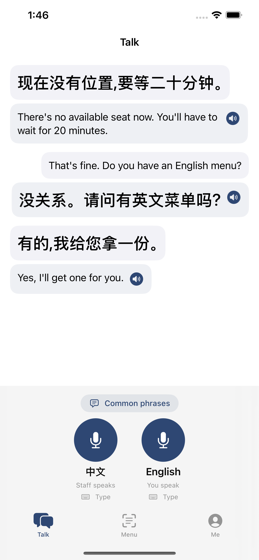
The bill please. No cilantro. Where's the restroom. Tap and it speaks Chinese — no connection needed.
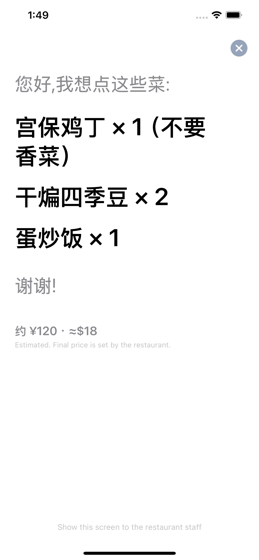
Build your order, add notes like 不要香菜, hold up the screen. It stays awake while the waiter reads it.
ChinaCue tells you what a dish may contain — never what it doesn't. When a dish's heat can't be judged reliably, it says so instead of guessing.
Always confirm with restaurant staff before eating, especially with a food allergy. The same dish is cooked differently in every kitchen, and no app can see the plate in front of you. ChinaCue is there to help you ask better questions — not to replace asking.
Your first 2 successful menu captures and first 30 conversation translations are free. Preset phrases and order cards are always free. Trip Pass adds 200 menu captures and 2,000 translations. Explorer Pass adds 500 menu captures and 5,000 translations. Both passes never expire and can be purchased again when you run out. Remaining counts are stored on your device.
No account. No sign-up. No ads. No tracking.